Можете посоветовать курсы по биоинф. с нуля?
На Ютубе, курсэре и т.д.
Можете посоветовать курсы по биоинф. с нуля?
На Ютубе, курсэре и т.д.
С чего начать изучение биоинформатики - Биология - Спроси! | Beyond Curriculum С чего начать изучение биоинформатики - Биология - Спроси! | Beyond Curriculum
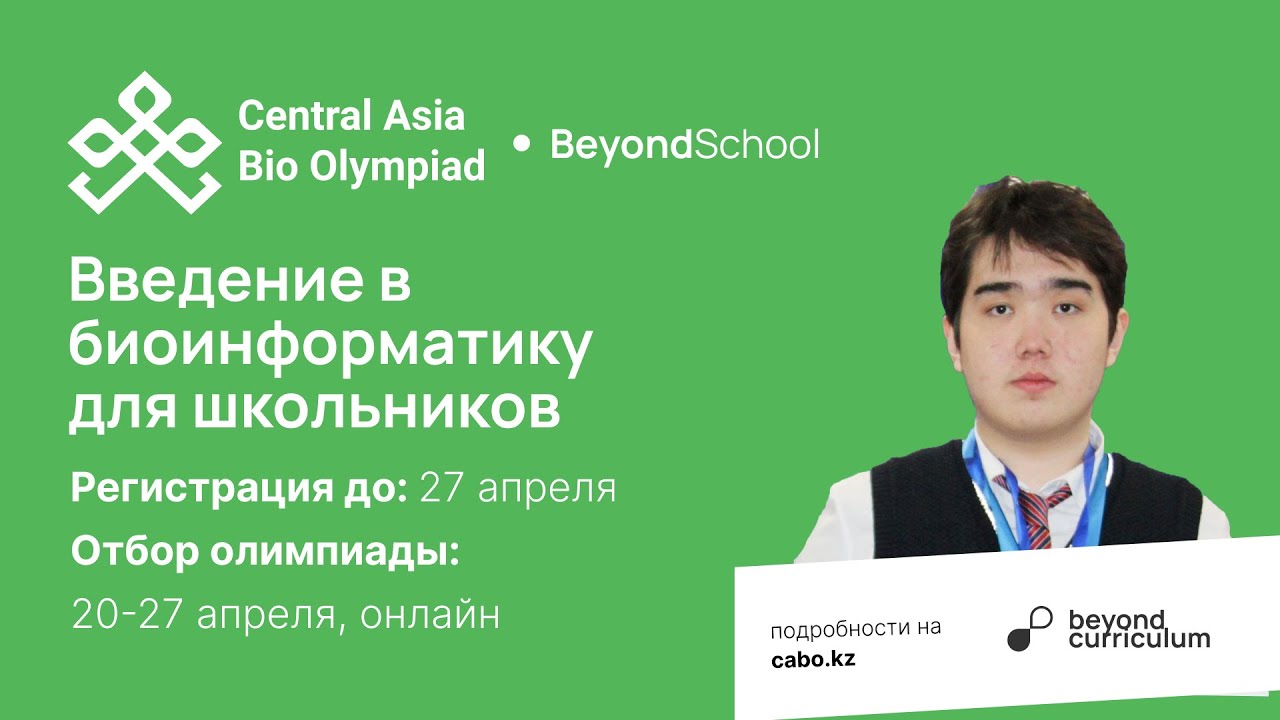
@beyhan записал два года назад вот такое видео по введению в биоинформатику:
подозреваю что форум умер, и эта тема мб не актуальна но я вспомнила что тут спрашивал/а/и, и думаю кому-то пригодиться. Initially the post was written for the English-speaking individ-s so it is in English. I deleted my account, and I previously commented here with Youtube lectures but I understood it is pretty boring to learn this way. So I recommend another plan.
First, you need to understand the bioinfo concepts. Lots of info is not structured, some books can be toooo boring to read. If you would like to employ online format, I recommend Free Online Bioinformatics Course from Alison with the great theory, well-structured bioinformatics role + overall picture of all processes. The description: «Did you know that algorithms are used in the majority of bioinformatics work? This free online science course will teach you the essentials of bioinformatics. You will learn about various algorithms, tools, and procedures and the role of bioinformatics in discovering, designing and developing drugs will also be discussed. You will get to understand fundamental concepts and their contributions to this growing field». And you need to learn biology basics, undoubtedly: DNA, RNA, genes, proteins, transcription, translation, mutations, enzymes, sequencing, and whatever further.
After that, you need to choose what you should focus on later. Bioinformatics is extensive. There are at least genomics and proteomics two major fields. Choose something one, and then apply practical skills. It could take more than the whole life to know all, so I would ask what is your purpose, and focus on that. For example, bioinformatics can be used to compare DNA or protein sequences; analyze genome sequencing data; study gene expression; predict protein structure or function; find disease-related mutations; work with drug discovery data and whatever.
If you want to practice, you need to know programming: Python, and later maybe R, especially if you want RNA-seq/statistics/plots/professional bioinformatics but I guess you are not planning it. You also need good tech problem-solving skills. Practice is the only way:
1. Firstly, Python should be your good friend. Exercism is a good intro for beginners to solve easy tasks. Of course, you can learn Python coding on Leetcode etc. just to train basics, but they are pure Python, not Bioinformatics yet. By basics I mean: variables, loops, functions, lists and dictionaries, reading and writing files, working with strings, etc. Then move to simple biological tasks, for example: count nucleotides in a DNA sequence; calculate GC content; transcribe DNA to RNA; translate RNA to protein; find motifs in a sequence; parse FASTA files. Learn basic bioinformatics file formats too: what they mean, what they contain, and why people use them.
2. So, Biopython is what I can recommend next. You should be comfortable with Linux/command line, Python, basic statistics, Git, and working with files.
By basic statistics, I don’t mean something super advanced at the beginning. I mean: mean, median, variance, standard deviation, probability basics, distributions, correlation, regression basics, p-values, hypothesis testing, confidence intervals, and multiple testing correction. Try to understand in the context of the bioinformatics. Multiple testing is especially important later, because in bioinformatics you may test thousands of genes at the same time.
By Git, I mean the basic tool for saving and tracking your code. At least know git clone, git add, git commit, git push, git pull, and how to upload your small projects to GitHub with a README file. You do not need to be a Git master, but you should not lose your scripts every time you change something. Is not necessary btw but if you wanna read and write projects, yes.
By working with files, I mean opening, reading, editing, cleaning, and saving data files. In genomics, you will constantly meet formats like FASTA, FASTQ, SAM/BAM, VCF, GFF/GTF, BED, CSV/TSV, etc. You should know how to read files line by line in Python, split columns, save output, work with folders and paths, and inspect files from the terminal using commands like head, tail, less, grep, and wc.
For Python, Biopython is useful because it helps you work with sequences, BLAST, NCBI Entrez, alignments, phylogenetics, motifs, and biological file formats. I would not say it is only a “course”; it is more like a real Python library with a very useful tutorial. So it is good after you already know Python basics.
3. After you know some Python and basic biology, use Rosalind. The gold standard for bioinformatics learning is Rosalind (after the name of great Rosalind Franklin, sorry for Watson & Crick). It offers a problem-solving platform where you learn algorithms by solving evolution, assembly, and genetics problems step-by-step.
It teaches bioinformatics through small programming problems. The platform includes topics like string algorithms, alignment, dynamic programming, genome assembly, phylogeny, probability, and computational mass spectrometry.
So «The Python Village» (in Rosalind page) is exactly for beginners, the copy of Python basics actually. Then, «Bioinformatics Stronghold» (in Rosalind page) is something you should apply after appropriate Python knowledge. This is the main beginner bioinformatics section. Here you start solving biological problems with code.
Examples of tasks: counting DNA nucleotides; transcribing DNA into RNA; finding the reverse complement of DNA; calculating GC content; counting point mutations; using Mendel’s law; translating RNA into protein; finding motifs in DNA; building consensus sequences; working with open reading frames; RNA splicing; calculating protein mass; genome assembly basics; sequence alignment; phylogenetic trees.
After that, try Bioinformatics Armory, but what I wrote is already enough if you are not planning doing it on a professional level. I am not on that level either so I cannot give a review or recs.
4. Additional, more practical and less coding-heavy way: Galaxy Training. The Galaxy Training page describes itself as a collection of tutorials. The homepage lists tutorials on topics such as genome annotation, microbiome, proteomics, single-cell analysis, transcriptomics, variant analysis, and sequence analysis. It is a scientific platform designed to make computational biology accessible without programming experience. For example, you can practice quality control of sequencing reads, mapping reads to a genome, genome assembly, RNA-seq analysis, differential gene expression, variant calling, and so on. So Rosalind is more about coding and algorithms, while Galaxy is more about real workflows with existing tools.
Still, I am not talking about R progr. langauge. At this point, I am not pro, and I believe all listed above are pretty enough for now. There are more but I suggest main ones.
I found some useful sources dedicating maybe at least 500 hours checking them. In the context of the post, I worked through the Biopython and solved all «Bioinformatics Stronghold» problems in Rosalind, so you can ask me if you have questions. Wish you patience