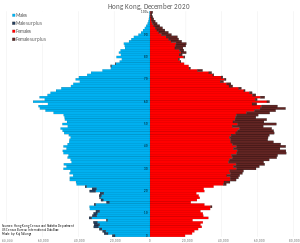
Почему в Гонконге так много женщин?
6 лайков
Обычно значимая разница в соотношении полов, в особенности, в группах среднего возраста, может быть связана с трудовой иммиграцией (прим. Катар, где в преддверии Кубка Мира было сосредоточено большое количество рабочих из юго-восточной Азии). После небольшого исследования в поисковике, пришла к тому, что в Гонконге почти та же ситуация, но преимущественно в сфере домашнего труда.

На английском языке, в принципе, немало источников, погружающихся в этот вопрос.
12 лайков
Я давно читал статью, в которой сообщалось, что китаянки с материка приезжают рожать в Гонконг, чтобы получить паспорт Гонконга для детей по рождению и для себя в будущем по проживанию. Гонконг, как бывшая колония, отличается от остального Китая правами человека и западными ценностями. Местные женщины в Гонконге все чаще остаются одинокими, так как для них в первую очередь это социальная независимость и успех в карьере. Потому мужчинам в Гонконге намного удобнее жениться на приезжих с материка, так как материковые китаянки имеют меньше амбиций в личной жизни и их самих интересует жизнь в более «свободном» регионе, а паспорт можно получить лишь заключив брак с жителем Гонконга. Причиной являются китайские традиции в семье, где женщина должна жертвовать ради семьи, что для коренных становится все более неуместно.
Но наверное данные факторы лишь одни из причин, почему демографическая пирамида Гонконга сильно отличается от других азиатских стран.
8 лайков
@eudaimon if you look at the demographics pyramid for Hong Kong, you’ll find that there’s a significant excess of women. What are the reasons for that?
3 лайка
The demographic pyramid of Hong Kong, as depicted in the image provided by Yerali, shows a significant excess of women in certain age groups. There are several factors that could contribute to this phenomenon:
-
Labour immigration: As aisford mentioned, the pattern of having more women in certain age groups could be due to labour immigration. In Hong Kong, there is a demand for domestic workers, many of whom are women from Southeast Asian countries. These women come to Hong Kong for employment opportunities and contribute to the higher female population.
-
Mainland mothers: Talgat’s point about women from mainland China coming to Hong Kong to give birth is another factor. This practice, known as “birth tourism,” was common because children born in Hong Kong would be entitled to Hong Kong residency and, by extension, different rights and opportunities compared to mainland China. This could lead to a temporary increase in the number of women, especially in maternity wards or among the population of new mothers.
-
Societal and cultural factors: As Talgat also noted, societal preferences and shifts in cultural values might influence demographic patterns. In Hong Kong, there may be a trend of women prioritizing career and personal independence over marriage and family, which can affect demographic statistics.
-
Longevity: Women tend to live longer than men, which is a global trend. This results in a higher number of elderly women compared to elderly men, which can be observed in many demographic pyramids around the world.
-
Marriage patterns: The preference for marrying women from mainland China, as mentioned by Talgat, can also influence the gender balance in the population.
-
Historical events: Past events such as migrations, wars, or economic crises can have long-lasting effects on the demographic structure of a population.
To fully understand the reasons for the significant excess of women in Hong Kong’s demographic pyramid, one would need to analyze statistical data, immigration records, birth and death registries, and consider the sociocultural context of both Hong Kong and the surrounding regions.
11 лайков