Пожалуйста, помогите в решении этой проблемы.
How will we solve this problem? I am very confused.
2 лайка
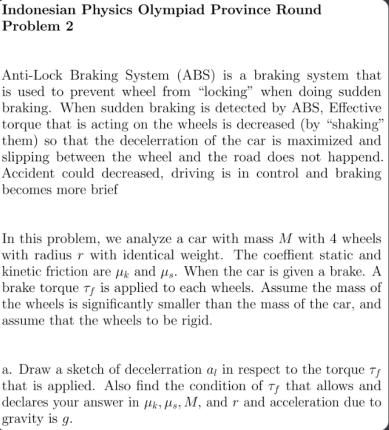
In this problem the weight P=Mg/4 is applied to each wheel (there’s no information about the position of car’s center of mass, so the difference between forces due to acceleration is ignored (which is nearly true for sports cars)), so there also appears friction f\leq\mu_sP for non-slipping condition and f=\mu_kP when the wheel is slipping (in most problems that introduce both coefficients of static and kinetic friction it is assumed that \mu_s>\mu_k, which is obvious).
So we’re writing two equations (seems like it’s a four-wheel-drive car; also I assume that car decelerates when a<0 and angular acceleration is in same direction as \omega>0):
Ma = \mp4f, \quad I\varepsilon = -\tau_f \pm fr.
Next we need to analyze the motion. When the slipping condition occurs, we have v\neq\omega r. Let’s first say that v>\omega r, then we put \pm\rightarrow+. If the initial speed was v_0, then initial angular speed was \omega_0 = v_0/r, hence
v(t) = v_0 + at,\quad \omega(t) = \omega_0 + \varepsilon t,
and therefore the slipping condition is a>\varepsilon r. In this case f=\mu_kMg/4. Plugging this condition into our equations, we have
\tau_f > \frac{f}{Mr}(4I+Mr^2)\approx fr = \frac{\mu_kMgr}{4}.
This condition implies that if \tau_f>\mu_kMgr/4, then deceleration is constant and equals a=-\mu_kg.
Next condition: v<\omega r. In this case \pm\rightarrow- and a<\varepsilon r, thus \tau_f<-fr(1+4I/Mr^2), which makes no sense because ABS doesn’t increase angular speed.
The final condition: v=\omega r, or \tau_f = fr(1+4I/Mr^2)\approx fr. Note that in this case f\leq \mu_s P, so the relationship between torque and acceleration is
a=-\frac{4\tau_f}{Mr}.
The “minus” sign is ok because we need deceleration, so it’s fine to rewrite it as a=4\tau_f/Mr \leq \mu_sg. So the graph consists of a linear part until a\leq \mu_sg and \tau_f\leq\mu_sMgr/4 and horizontal line of a=\mu_kg in \tau_f>\mu_k Mgr/4.
The final question arises: if I said that \mu_s>\mu_k, then we have an interval of
\frac{\mu_sMgr}{4}\geq\tau_f>\frac{\mu_k Mgr}{4}
where both slipping and non-slipping conditions hold simultaneously. There’s nothing wrong about it, because these conditions also depend on previous state of car’s motion, so-called “hysteresis”. We may, for example, gradually increase \tau_f – in this case the car doesn’t slip until \tau_f=\mu_s Mgr/4 because v=\omega r condition is kept. But if we accidentially get v>\omega r (by, let’s say, instantly applying a torque \tau_f>\mu_kMgr/4), then the wheels will always slip while \tau_f>\mu_kMgr/4. The main purpose of ABS is to keep both conditions \tau_f=\mu_s Mgr/4 and v=\omega r.
Important: I’m not sure whether I am correct about my explanation or not. But ABS indeed monitors the rotation of wheels and, if they are blocked (and slipping occurs), slightly reduces the pressure in the brake system to allow the wheel to turn. Without ABS the car can even randomly turn around during the sudden braking because some of the wheels can rotate at the same time the others are blocked, and the friction makes a non-zero torque with respect to the center of mass of the car.
7 лайков
Thanks a lot! I understand the whole situation now. 
1 лайк
I cross checked and your explanation and answers are absolutely CORRECT. May I ask how should I develop such an amazing insight of physics as yours? You always know even the smallest of the details and concepts involved in the problem, it feels as if you are extraordinary!
4 лайка
thanks for these words!
lots of practice, i guess? i think it’s an average level of those who get to international olympiads (you’ll see my name when you check the results of the last APhO lol), just like, for example, Indian national team, which is indeed strong
4 лайка
Yeah, I know, you got a bronze in APHO (considered hardest in the world) and silver in IZHO. My physics coach says that all the top 3 medal winners have the same IQ and level of preparation and a lot of it depends on the day on the exam.
I practice a lot but the thing is, I am not that good at figuring out the situation and visualising the problems.
unfortunately, silver:(
yup, i’m completely agree
1 лайк
when you solve lots and lots of problems, you would gradually get used to it so you would instantly figure out an approximate solution just at first glance
1 лайк
Oh, I must be mistaken  but silver is also soo hard to get… It is a dream for me to even make it to the final team let alone winning a medal!
1 лайк
Oh ok, I’ll keep practising, hopefully I’ll get better with time, I guess.