3.7. The minimum strength of a uniform electric field which can tear a conducting uncharged thin-walled sphere into two parts is known to be E_0 .
Determine the minimum electric field strength E_1 required to tear the sphere of twice as large radius if the thickness of its walls is the same as in the former case.
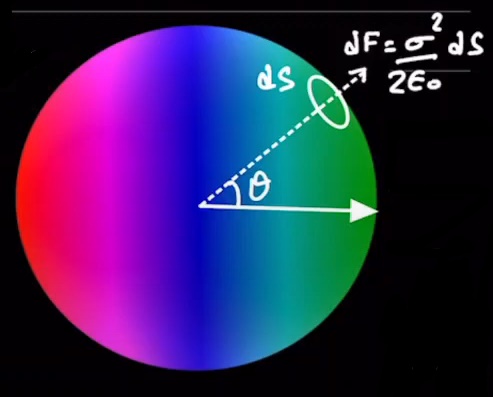
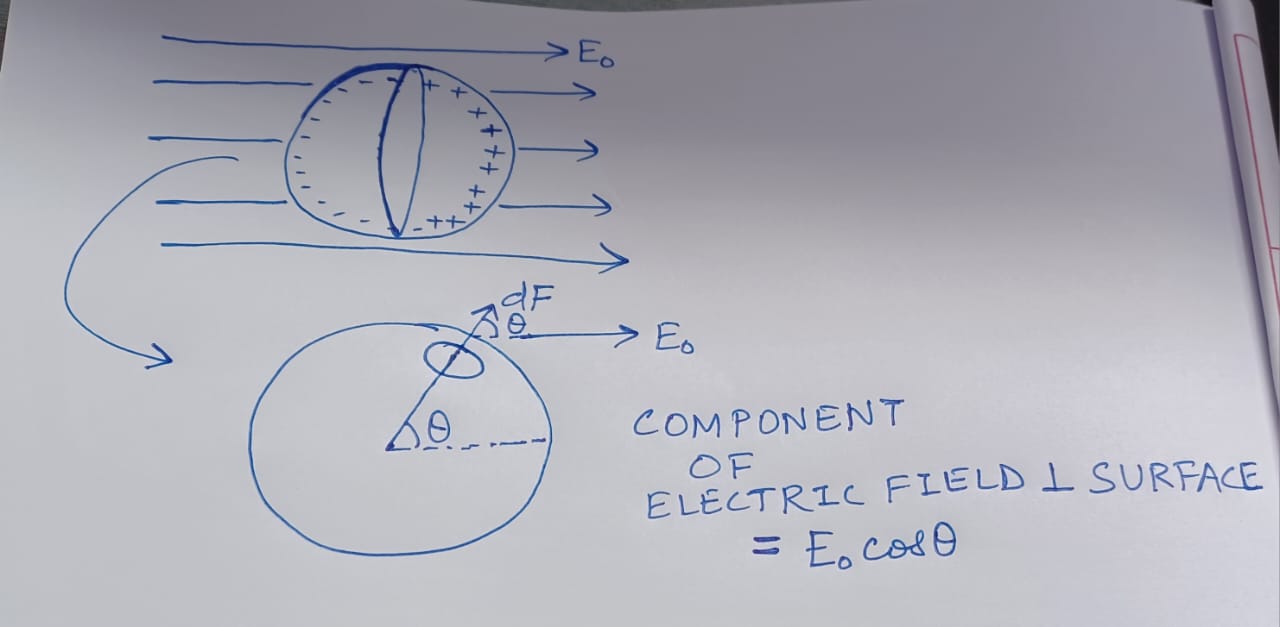
In this problem, I seem to understand what the solution is trying to say, however, I have a doubt. How can we solve this problem by writing force on negatively charged half? All solutions online write the force exerted on a patch of area dS at angle \theta from the x axis and since electric field is zero inside the sphere, we can find E_0 = \frac{\sigma_0}{\epsilon_0}. And, as we can see force on the patch dF = \frac{\sigma^2}{2\epsilon_0} * dS. And, from observation we can see that F is proportional to R^2 and {E_0}^2 and hence the factor is \frac{1}{\sqrt2}.
How can we solve this problem by writing force on negatively charged patch of same area? Also, the force dF which we found above, I am unable to understand what is this force the result of? Is this force the result of the electric field E_0 or something else?
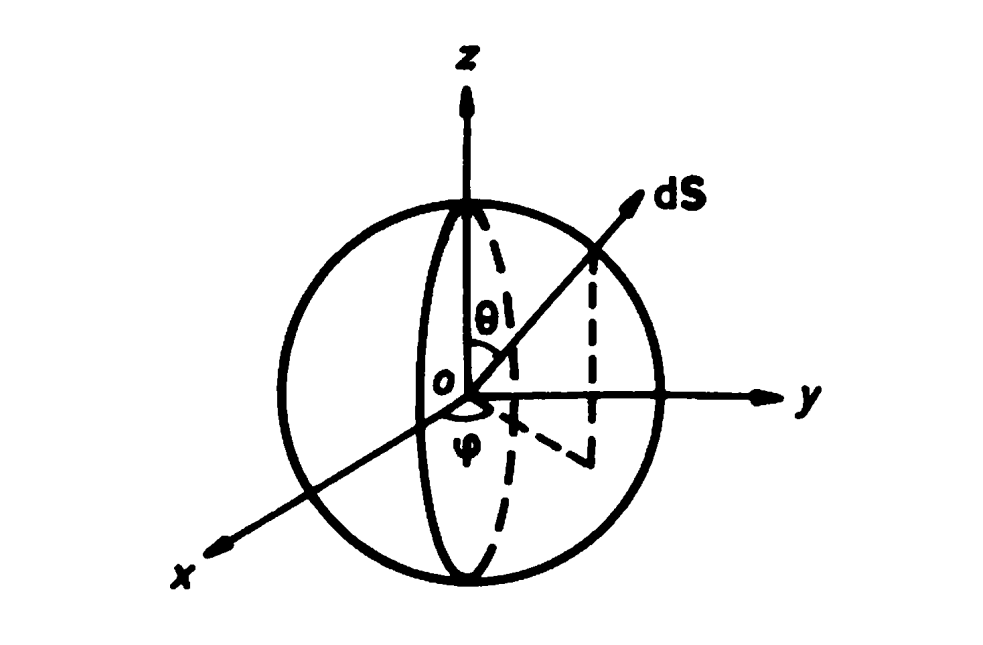
We can actually find the force on one half of the sphere. We should use the spherical coordinates and project the force to the normal of the cross-section of the other half:
If we use the fact that \sigma=\frac{Q}{4\pi R^2}, we get
F=\frac{Q^2}{32\pi\varepsilon_0R^2}
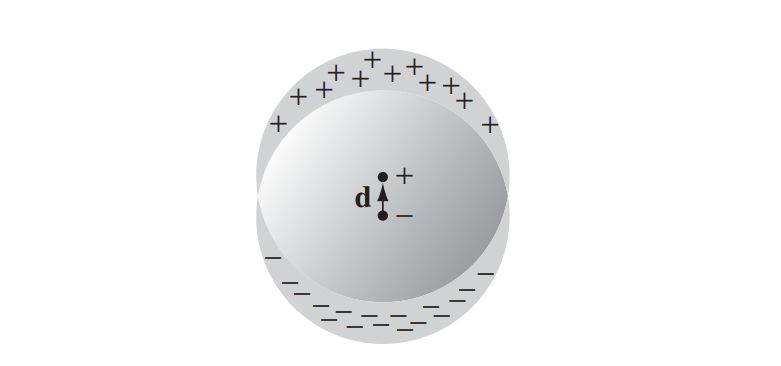
I think that now we can use the dipole representation of the interaction of two halves. Why? Because when the neutral sphere is subjected to an external field it becomes polarized and we can look at the intercation of the halves as to the interaction of two point charges which are located a very small distance away from each other. The dipole moment of such configuration:
\vec p=4\pi R^3\vec E_{ext.}
I’m pretty sure that you know how to derive this formula (you can do it by taking a look at two spheres which are slightly removed from their initial position due to polarization)
The field of such dipole is \vec E=\frac{1}{4\pi\varepsilon_0}\left(\frac{3(\vec p\vec r)\vec r}{r^5}-\frac{\vec p}{r^3}\right) and the force on a dipole \vec F=(\vec p\nabla )\vec E_{ext.}. You can see that the force between the halves is F\propto\left(\frac{Q}{R}\right)^2 (from the integration) or F\propto \left(\frac{pE_{ext.}}{R}\right)\propto R^2E^2_{ext.} (from the dipole force formula
As I said the external field causes the polarization of the sphere and it is an alternative to a dipole
Thank you! So, from what I am able to understand, the external field is responsible for inducing the charges. I understood your spherical coordinates method. However, I am still having trouble understanding how will the force act on the left half of the sphere. The field inside the conductor will be zero after cancelling out the external field E_0. So how did we write the field of the dipole? And, the external field will apply pressure on the right half. But will this same external field also apply pressure on the left half too?
Yeah, that’s right. I just wrote it to remind you about the formula for the field of the dipole (or i wanted to introduce you with it if you are not familiar with it), but in this problem we don’t have to do anything with it. Since the force on a dipole depends only on the external field - its the only thing we care about
Yes. Why do you think the forces shouldn’t be the same?
Electric field just outside the dS area patch will be \frac{\sigma}{\epsilon_0}. This electric field will be due to the patch and the rest of the universe (including the conductor)
There is no electric field inside the spherical conductor.
Electric field on any patch(whether charge density is -ve or +ve) will be perpendicular to surface and E_{ext} = E_{patch} = \frac{\sigma}{\epsilon_0}.
The cancelling field generated inside for a short time to cancel out E_{0} has no effect on pressure.
My only doubt now is, that can you prove that at an outside point very close to a negatively charged patch, the electric field will still be \frac{\sigma}{\epsilon_0} directed away from the patch? That will clear up a lot of things for me.
@Damir One more doubt I have is that, will E_{ext} be equal to E_0 or not? I think if you can please prove the formula of E field just outside the patch, it will help me a lot.
Basically, if you could provide a proof for this problem it would clarify all confusions.
Problem: We have a solid conducting sphere having charge density \sigma = \sigma_0 * cos \theta. We have directed an electric field E_0 in the horizontal direction along the +x axis. The charge density will be distributed as shown in the figure. Assuming a patch of area dS on the surface of the sphere, please prove that the electric field at any point just outside the surface of the sphere will be \frac{\sigma}{\epsilon_0} directed perpendicular to the patch.
Will there be any forces of attraction between the negatively charged half and the positively charged half? Will we ignore them while calculating the pressure/force on the patch?
You should also take into account the \sin \varphi factor to get the normal projection
As said derived it before the force between the halves is F=\frac{Q^2}{32\pi\varepsilon_0R^2} and as I also mentioned it before we can represent the polarized sphere as a dipole. When we calculate force between the halves we take into account only the external field, because it is the external field, which causes the polarization of the initially neutral sphere and only because of it there is a force between the halves
It is a nice book. There is a pretty advanced book Introduction to Electrodynamics Griffiths and a really good book in russian Sivuhin electricity. However it doesn’t matter where you consume the information, if the resource is reliable and you are understanding everything excellent
Oh, thanks! I find Griffiths somewhat mathematically more challenging however, I’ll take a deeper look from now on. Do you take any tutoring/coaching from some teacher as well?