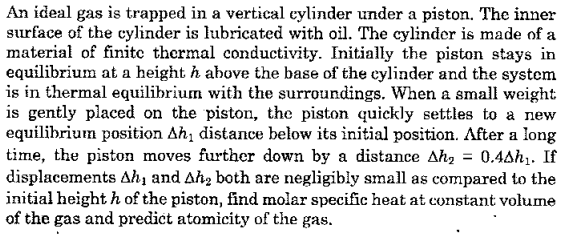
So here you can write the ideal gas law
p_0 Sh = \nu RT_0,
where p_0 is an atmospheric pressure and T_0 is a surface temperature (because at the start the system was both in mechanical and thermal equilibrium with the surroundings).
Then we place a small weight, giving an additional pressure mg/S to system (we don’t know the mass but further we can calculate it). Sentence “The piston quickly settles to a new equlubrium position \Delta h_1 distance below its initial position” implies that after reaching \Delta h_1, the system stays in mechanical, though not thermal equlibrium with the surface (well, oscillations of the piston also take place in this process here, but let’s think that the oscillation time is much smaller than specific time for system to cool down). So we use 1st thermodynamic law
Q = A+\Delta U,
but in this process Q=0. Also, adiabatic equation pV^\gamma=\text{const} does not work by the reason that this process is not quasistatic. How to calculate work A? Well, we can do it in terms of external pressure:
-A = (p_0+\frac{mg}{S})\cdot S\Delta h_1.
Here’s the “minus” sign before A because this is the work of external pressure. So,
\Delta U = \nu C_V(T_1-T_0) = (p_0S+mg)\Delta h_1,
and it is understood that T_1>T_0, so next the piston cools down until system reaches temperature T_0. But before cooling down, we may write another ideal gas law
(p_0 + \frac{mg}{S})S(h-\Delta h_1) = \nu RT_1,
and after a long time,
(p_0S+mg)(h-\Delta h_1 - \Delta h_2) = \nu RT_0
Then we can find C_V. Using equation for \Delta U (and expressing T_0 and T_1 from ideal gas equations),
C_V = R\cdot\frac{(p_0S+mg)\Delta h_1}{\nu RT_1-\nu RT_0} = R\cdot \frac{(p_0S+mg)\Delta h_1}{(p_0S+mg)(h-\Delta h_1) - (p_0 S + mg)(h - \Delta h_1 - \Delta h_2)}=R\cdot\frac{\Delta h_1}{\Delta h_2}=\frac{5}{2}R
Thus, gas is diatomic.