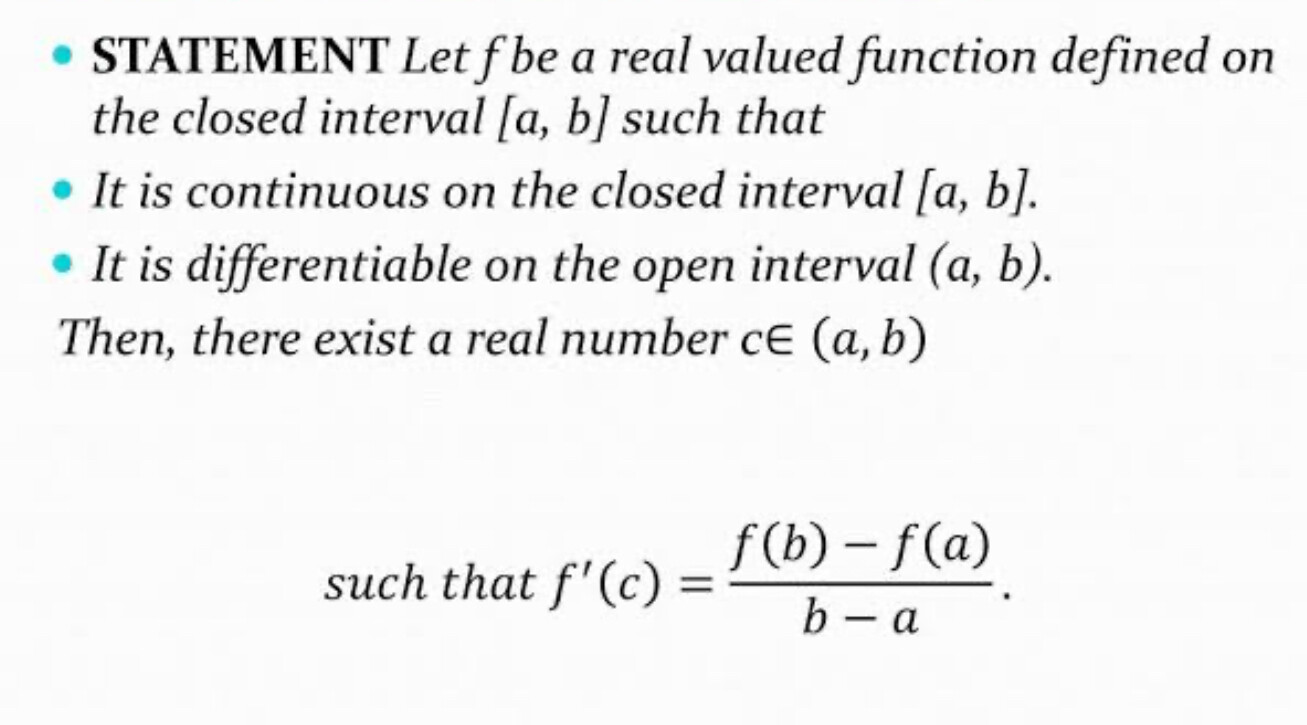
Can someone provide a kinda Mathematical Proof to this ?

1 лайк
Let’s imagine that such a point exists , and let’s call it that m=\frac{f(b)-f(a)}{b-a}
And let’s come up with another auxiliary function g(x)=f(x)-f(a)-m(x-a)
and we can see that in this function , when substituting a and b we get 0
this means that this function will definitely have an extremum point in between {(a,b)}
this means
g'(c)=0 or f'(c)-m=0 where c\in(a,b)
and after that our answer comes out
f'(c)=m=\frac{f(b)-f(a)}{b-a}
This is also called Rolle’s theorem
1 лайк
I think it is important to state that geometrically, g(x) is just the difference function between f(x) and the secant line that intersects the graph of f(x) (at least) at points a and b. This can be easily seen, if we rewrite g(x) as
g(x) = f(x) - \left( f(a) + \frac{f(b) - f(a)}{b-a}(x-a)\right)
Also, if we consider the case where a,b \in \mathbb{R} such that f(a) = f(b), then the theorem reduces to Rolle’s theorem. So, the core idea of this proof is to somehow reduce the general statement to its particular instance (Rolle’s theorem). With the geometrical interpretation of g(x) in mind, the motivation behind the definition of g(x) in that way is clear.
3 лайка
It seems to me that everything is logical there even without Rolle’s theorem. Your solution is also correct purely in geometric terms.
2 лайка